
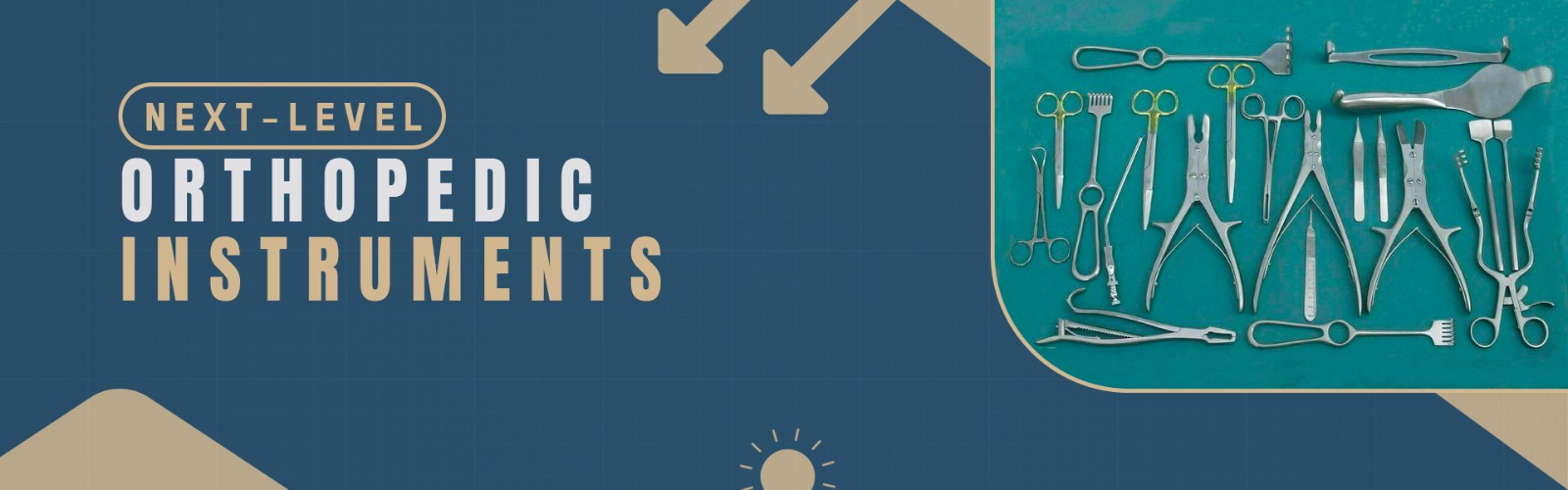
Craftsmanship Standards That Orthopedic Surgeons Rely On
Orthopedic surgery demands instruments that perform under the most physically demanding intraoperative conditions. Our manufacturing standards are built around that reality — not around shortcuts.
Forged Precision Manufacturing
Drop-forged from solid steel billets — grain structure aligned for maximum impact resistance and rigidity under surgical loads. Post-forging CNC machining ensures exact dimensions.
Global Export Network
Supplying hospitals, distributors and procurement organizations in 40+ countries with full commercial documentation, reliable logistics and bulk shipment expertise.
OEM & Private Label
Build your own branded line — logo engraving, custom packaging, kit assembly, and distributor-specific catalog configurations with flexible MOQs.
Multi-Stage Quality Control
Dimensional checks, surface finish inspection, edge sharpness testing, joint tension evaluation and final visual approval on every instrument.
Dedicated Wholesale Support
Responsive account managers for quotes, sampling, catalog requests and OEM coordination — available via email, phone or WhatsApp.
Manufacturer-Direct Pricing
No middlemen — competitive wholesale rates for clinics, hospitals, distributors and large-volume supply agreements.

Awls & Bone Hooks
Straight and curved bone awls for cortical perforation and hooks for traction during open procedures
View Category →Bone Holding Instruments
Reduction clamps, bone-holding forceps and fragment holders for fracture fixation
View Category →Bone Mallets & Tamps
Stainless & aluminum mallets with interchangeable heads
View Category →Chisels & Gouges
Lambotte chisels and curved gouges
View Category →Bone Cutters
Double-action bone cutting forceps
View Category →Bone Saws
Gigli wire saws and amputation saws
View Category →Wire & Pin Cutters
Heavy-duty cutters for surgical wires
View Category →Osteotomes
Precision bone division instruments
View Category →Elevators
Periosteal elevators & bone levers
View Category →Hand Drills
Manual surgical drilling systems
View Category →
Impact-Rated Steel for Bone Work
High-carbon and chrome-vanadium steel ensures long-term durability under repeated surgical impact.
Precision-Ground Cutting Edges
Consistent sharpness reduces effort, heat generation, and improves surgical accuracy.
Ergonomic Handles
Designed for controlled force transmission and reduced fatigue during long procedures.
Autoclave-Durable Finish
Corrosion-resistant surfaces maintain performance through repeated sterilization cycles.
Bulk Order Consistency
Strict quality control ensures uniformity across large production batches.
Who Relies on Our Orthopedic Instruments
Serving surgeons, hospitals, and distributors worldwide with precision-engineered tools.
Orthopedic Surgeons
Fracture fixation & joint procedures
Hospitals
OR inventory & surgical kits
Distributors
Wholesale & private labeling
Medical Institutes
Training & simulation labs

Orthopedic Hospitals & Surgery Centers
High-volume orthopedic hospitals and ambulatory surgery centers sourcing bone instruments.
Orthopedic Surgical Distributors
Distributors building orthopedic instrument catalogs.
Medical Schools & Programs
Training institutions requiring standardized kits.
Research Institutions
Labs using precision tools for testing.
Medical Supply Companies
Supply companies expanding instrument offerings.
Private Label Brands
OEM manufacturing with branding support.
Request Wholesale Pricing or Orthopedic Instrument Catalog
Tell our wholesale team about your requirements and we will respond within 24 business hours with instrument pricing, catalog access, and product availability details.
24-Hour Quote Turnaround
Wholesale pricing and catalog delivered within one business day.
Full Catalog Access
Complete orthopedic instrument catalog with pricing tiers.
Sample Evaluation
Request physical samples before placing bulk orders.
WhatsApp Support
Direct fast communication with our sales team.
Get Your Wholesale Quote
OEM Manufacturing Process
- 01
Specification Submission
Provide instrument types, design preferences, and volume requirements.
- 02
Feasibility & Pricing
Engineering review with detailed quotation and timelines.
- 03
Sample Production
Prototype instruments for evaluation before mass production.
- 04
Branding Approval
Finalize engraving, packaging, and brand identity.
- 05
Production & Export
Full production with inspection and export documentation.
Custom Orthopedic Instrument Manufacturing
Build your own orthopedic brand with complete OEM support — from manufacturing to branding and global distribution.
Logo Engraving
Custom branding on instruments with precision engraving.
Custom Packaging
Retail-ready branded packaging and kits.
Kit Assembly
Procedure-based surgical kits tailored to your needs.
Export Docs
Complete documentation for international shipping.
Wholesale Orthopedic Instruments:
A Complete Procurement Guide for USA Buyers
What Are Orthopedic Surgical Instruments and Why Do They Require Specialized Manufacturing?
Orthopedic surgical instruments are a distinct category of surgical tools designed specifically for procedures involving bones, joints, cartilage, ligaments, and musculoskeletal structures. Unlike soft-tissue surgery instruments — which prioritize delicacy and fine manipulation — orthopedic instruments must withstand repetitive mechanical stress, impact forces from mallet strikes, and the resistance of cortical bone during cutting, drilling, and shaping procedures.
This functional demand makes the manufacturing of orthopedic instruments fundamentally different from general surgical instrument production. Bone instruments require steel alloys with specific impact toughness and fatigue strength, not just corrosion resistance. They require forging rather than casting, heat treatment for defined hardness profiles, and edge geometries engineered to cut through dense cortical bone without fracture or deformation. Understanding these manufacturing requirements is essential for any procurement professional evaluating orthopedic instrument suppliers.
Key Orthopedic Instrument Categories and Their Clinical Applications
Bone awls and bone hooks are among the most fundamental orthopedic instruments — awls create cortical bone entry points for screws, pins, and wires, while bone hooks provide traction and manipulation of bone fragments during reduction. Both require sharp tips and rigid shafts capable of transmitting controlled force into dense bone without deflection.
Bone holding forceps and reduction clamps maintain bone position during fracture repair — a function that demands enormous clamping force stability without crushing the periosteum or creating secondary bone trauma. Properly engineered bone holding instruments use ratchet locking mechanisms with defined force increments and jaw profiles matched to cortical bone anatomy.
Bone mallets and tamps are impact instruments used to seat osteotomes, chisels, implants, and bone grafts. Mallet quality determines the predictability of force transmission — well-balanced mallets with appropriate weight and head material (stainless steel or aluminum) convert surgeon input into controlled, consistent impact forces that reduce instrument-related complications during joint arthroplasty and reconstructive procedures.
Chisels and gouges are precision cutting instruments for bone shaping — chisels produce flat planar cuts while gouges produce concave or convex channels in cancellous and cortical bone. Edge geometry and blade width selection determine the accuracy and smoothness of bone cuts in procedures ranging from osteotomy to joint surface preparation. Osteotomes are a related category used specifically for bone division without a saw — requiring particularly precise bevel angles and edge sharpness for clean, controlled separation at the bone interface.
Bone cutters and rongeurs perform bone removal and trimming — cutters for larger bone sections, rongeurs for fine nibbling of bone edges and spurs. These instruments must balance jaw sharpness for effective cutting with frame rigidity to avoid instrument failure under the substantial forces involved in bone removal.
What Materials Are Used in Orthopedic Surgical Instrument Manufacturing?
The demanding mechanical requirements of orthopedic surgery necessitate careful material selection beyond standard surgical stainless steel. Chrome-vanadium steel (CrV) is widely used for mallets, chisels, gouges, and bone cutters — providing a combination of hardness (for edge retention), toughness (for impact resistance), and ductility (to avoid brittle fracture under surgical stress). This alloy is heat-treated to defined Rockwell hardness values specific to each instrument type.
420-grade high-carbon stainless steel is used for instruments requiring both corrosion resistance and edge hardness — including osteotomes, elevators, and awls. 316L stainless is selected for instrument components where biocompatibility and corrosion resistance are the primary requirements. For bone holding forceps and reduction clamps, 17-4 PH stainless steel may be used to achieve the high yield strength needed for reliable clamping force without instrument deformation.
How to Source Orthopedic Instruments Wholesale for USA Hospitals and Distributors
Sourcing orthopedic instruments through wholesale channels requires a structured evaluation approach. The most important distinction is between trading companies (who resell instruments manufactured by others) and actual manufacturers (who control their own production processes). Manufacturer-direct sourcing eliminates intermediary pricing markups, allows direct quality oversight, enables OEM customization, and creates a single point of accountability for production and delivery.
For USA-based hospital procurement teams and medical distributors, evaluating an orthopedic instrument manufacturer should include: requesting sample instruments for physical performance evaluation, asking about manufacturing processes (forging vs. casting), understanding the supplier's quality inspection protocol, verifying export track record and logistics capability, and assessing responsiveness and communication quality during the inquiry process itself.
Bulk purchasing of orthopedic instruments delivers clear financial advantages — per-unit costs drop significantly at wholesale volumes, procurement administrative burden consolidates when sourcing from a single manufacturer, and instrument standardization across ORs simplifies sterilization, count procedures, and staff training. For distributors, reliable manufacturer relationships with consistent quality and predictable lead times are the foundation of competitive service delivery to hospital and clinic customers.
Orthopedic Instrument Sets and Kit Assembly for Hospitals and Medical Education
Many orthopedic buyers — particularly hospitals preparing for specific procedure types and medical schools establishing simulation labs — benefit from pre-configured instrument sets rather than individual item purchasing. Trauma instrument sets for fracture fixation, arthroplasty instrument sets for hip and knee replacement procedures, and basic orthopedic sets for general bone surgery each have distinct composition requirements that can be addressed through custom kit assembly programs.
For medical schools and orthopedic residency programs, standardized student instrument kits containing fundamental bone instruments — awls, mallets, chisels, elevators, and bone hooks — enable consistent training experiences across all students while simplifying institutional procurement. Custom kit assembly with OEM branding allows institutions and distributors to present these sets under their own identity, adding perceived value and brand equity to instrument supply programs.
Get Your Quote
Request wholesale pricing and full catalog for your orthopedic procurement program.
Request Catalog[ Sales Contact ]
Questions about orthopedic instrument availability, OEM programs, or bulk pricing? Our team is ready.
Submit Inquiry →
Where can I buy orthopedic instruments wholesale in the USA?
Orthopedic instruments for the USA market are sourced through specialized manufacturers who export directly to US hospitals, distributors, and surgery centers. Our wholesale program is open to orthopedic facilities, medical distributors, and procurement organizations across all US states. Submit an inquiry through this page to receive pricing and catalog access within 24 business hours.
What materials are used in orthopedic surgical instruments?
High-quality orthopedic instruments use chrome-vanadium steel and high-carbon stainless steel (410, 420 grades) selected for impact toughness, edge hardness, and fatigue resistance — properties critical for bone-contact instruments. Bone holding forceps may use 17-4 PH stainless for high yield strength, while corrosion-critical components use 316L stainless steel. All materials are passivated for autoclave compatibility.
Can orthopedic instruments be customized for distributors and brands?
Yes. We offer full OEM and private label services for orthopedic distributors and surgical brands. Customization includes laser-engraved logos on instrument handles and shanks, branded packaging and pouches, custom kit assembly for specific procedure types (trauma, arthroplasty, spine), and export documentation for USA import compliance. Contact our team to discuss OEM requirements and minimum order quantities.
Do you supply orthopedic instruments in bulk to hospitals?
Yes. Bulk supply to orthopedic hospitals, ambulatory surgery centers, and medical distributors is our primary business model. We accommodate high-volume orders with volume pricing tiers, priority production scheduling, and dedicated account management. Annual supply agreements with consistent delivery schedules are available for qualifying hospital and distributor partners.
How can hospitals and clinics request orthopedic instrument wholesale pricing?
Submit a wholesale inquiry through the form on this page with details about your facility, instrument categories of interest, and estimated quantity needs. Our orthopedic instrument team responds within 24 business hours with tailored pricing and catalog access. WhatsApp is also available for faster communication and quick catalog requests from procurement teams.
What is the difference between bone chisels and osteotomes?
While both instruments are used for bone division, chisels have a bevel on one side and are designed for general bone cutting and shaping — driven by a mallet to produce planar or angled cuts. Osteotomes are beveled on both sides (double-bevel), producing more controlled, symmetric bone division without the saw-tooth pattern of a chisel. Osteotomes are preferred in delicate anatomical areas where precise bone splitting is required, such as sinus floor elevation or controlled cortical osteotomy.
Do you supply orthopedic instruments for medical school training programs?
Yes. We supply standardized orthopedic student instrument kits and bone instrument sets for medical schools, osteopathic programs, and orthopedic residency simulation labs. Kits are configurable to curriculum requirements and available in bulk quantities at educational pricing. Consistent quality across batches ensures all students work with equivalent instruments.
Are sample orthopedic instruments available before bulk ordering?
Yes. Physical sample instruments for clinical evaluation and quality assessment are available for qualified buyers. Samples allow your surgical team or purchasing department to evaluate construction quality, edge sharpness, ergonomics, and finish before committing to wholesale quantities. Sample costs are credited toward subsequent bulk orders for approved accounts.
Looking for a Reliable Orthopedic Instruments Wholesale Supplier?
Whether you manage procurement for an orthopedic hospital, lead purchasing for a surgical distribution company, or source instruments for a medical education program — our team is ready to supply precision bone instruments at competitive wholesale pricing with full OEM capability.